
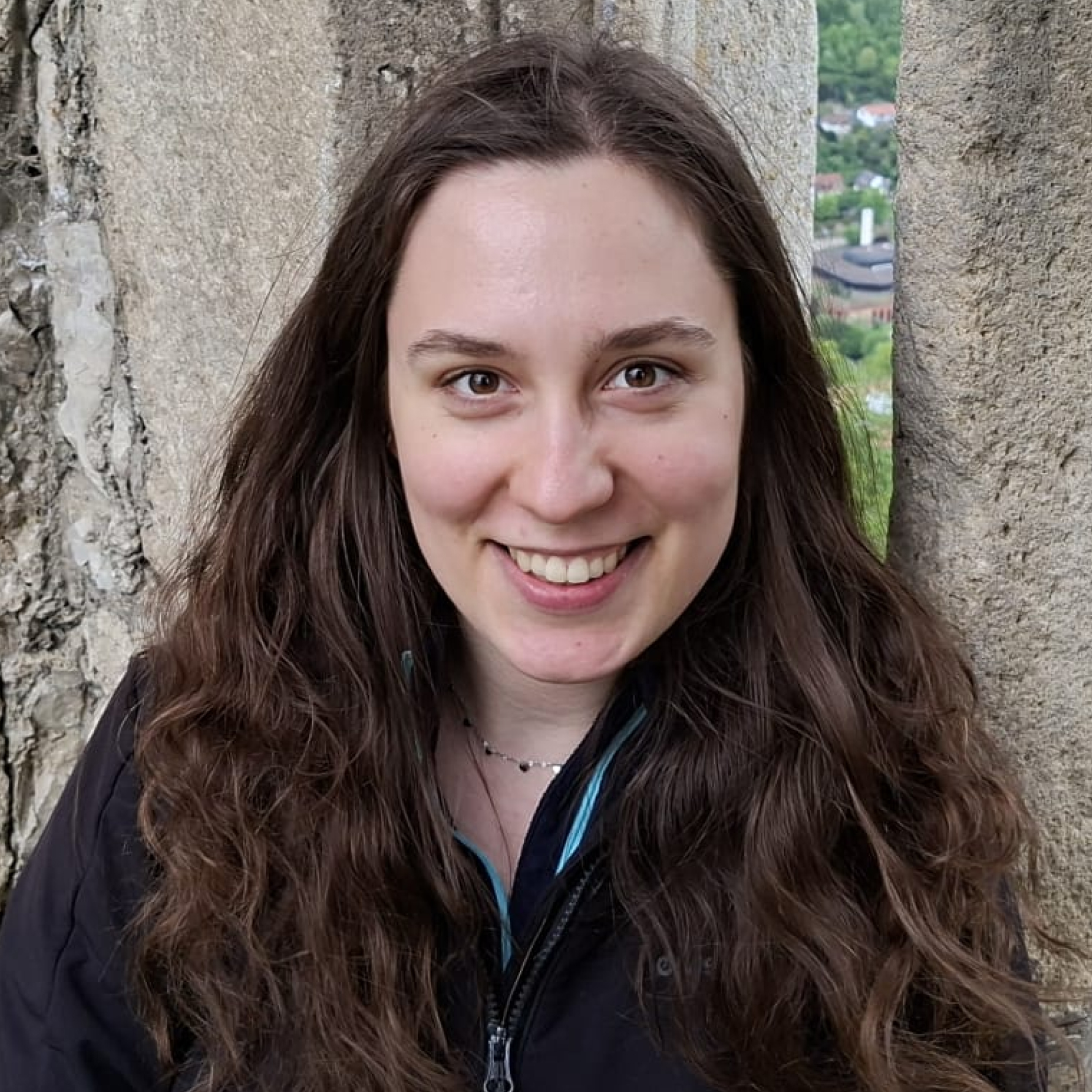
Veronika Lamparská
Research project
Spin- and orbitronics in chiral materials
Project supervisor
Prof. Jagoda Slawinska
Recruitment date
01/11/2026
My name is Veronika, and I grew up in the beautiful town of Trnava in Slovakia.
Here I studied until the age of 16, and afterwards moved to the United Kingdom for secondary school. I completed my bachelor’s degree in the Netherlands, specialising in nanophysics, during which I developed a strong interest in 2D materials. I became fascinated by how electrons can transport information not only via charge currents but also through spin currents, and how this could be used to design more efficient devices.
Supported by the Max Planck Institute for Solid State Research, I continued with my master’s studies in Physics at the University of Stuttgart. I conducted a part of my Master’s thesis at EPFL, where I worked on neural quantum states applied to moiré materials. It was a great experience, but I ultimately decided to go back to spintronics.
Through ORBIS, I am excited to gain new experiences in both industry and academia. In the long run, I would like to continue working in research, modelling electronic structures to predict and understand the behaviour of materials.
In my free time, I enjoy spending time outdoors, either hiking or rock climbing.
Project Description
This PhD project focuses on discovering new materials that can efficiently convert charge currents into spin signals, an essential functionality for next-generation, energy-efficient electronic devices operating without magnetic fields. Our recent work has shown that chiral crystals, whose structure lacks mirror and inversion symmetries, can perform this conversion far better than conventional materials. For example, in chiral tellurium we demonstrated an exceptional conversion efficiency of around 50% and unusually long spin relaxation times, enabled by strong polarization of the total angular momentum. The goal of this project is to find and understand new chiral materials that outperform Te, ideally with even higher efficiency and spin diffusion lengths reaching the micrometre scale, and consisting of lighter elements. The PhD candidate will contribute to this effort through three main directions:
Theoretical modelling: developing and applying methods to understand how spin and orbital angular momentum are generated and how they relax in chiral crystals. In some materials, orbital contributions are much larger than spin contributions; understanding and quantifying this behaviour is an important scientific challenge.
Symmetry analysis: using group-theoretical tools to identify which crystal symmetries can host persistent spin or orbital textures that protect the generated angular momentum and allow long-distance spin and orbital transport. This includes understanding the effects of reduced dimensionality at the nanoscale.
High-throughput materials discovery: performing automated ab initio calculations using Quantum Espresso and tight-binding Hamiltonians from PAOFLOW to screen a large number of chiral candidates. These simulations will account for realistic disorder effects (in collaboration with INL) and will identify promising materials for future devices.
Host institution
Rijksuniversiteit Groningen is a Top 100 (#69 in ARWU Shanghai Ranking 2024 and #79 in the World University Rankings 2024) research university where inter- and cross-disciplinary research leads to scientific breakthroughs and societal innovation and in which talented students are trained as innovators who will contribute to a sustainable society.
The Computational Materials Science group performs theoretical research focused on the design of novel materials and devices, whose functionalities emerge from the rich physics of spin-orbit interaction. In order to simulate structural, electronic, magnetic and transport properties of materials, Dr. Sławińska’s group uses computational approaches based on density functional theory complemented by tight-binding PAO Hamiltonians, Green’s functions methods and symmetry analysis. Current studies explore surfaces, thin films and hybrid structures, such as interfaces or van der Waals heterostructures, hosting quantum or topological phases that can be controlled by external stimuli.
Planned Secondments

Academic Secondment
Centre Interdisciplinaire de Nanoscience de Marseille (CNRS-CINaM)
Aix-Marseille, France
Aurélien Manchon

Industrial Secondment
SIMUNE
Donostia / San Sebastián, Spain
Mónica García Mota
Registering University
Rijksuniversiteit Groningen
Netherlands