
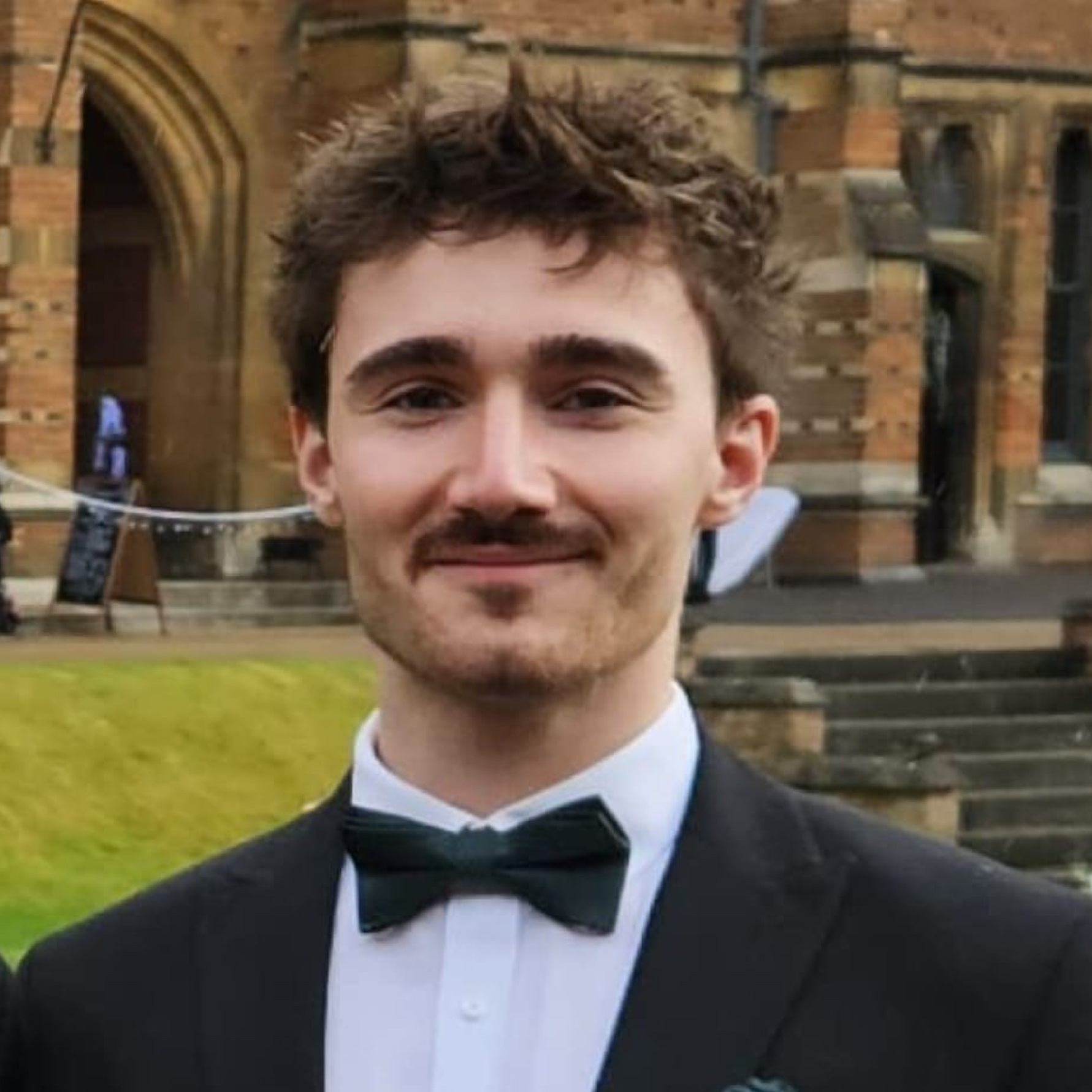
Josh Tyrrell
Research project
Orbitronics in van der Waals heterostructures
Project supervisor
Prof. Marcos Guimaraes
Recruitment date
01/10/2026
My name is Josh, and I come from Framlingham, a small town in England.
I completed an integrated Master's at the University of Oxford, specialising in condensed matter physics and quantum information. My Master's project focused on antiferromagnetism, and working in the topological magnetism group allowed me to develop my interest in skyrmionics, magnonics and spintronics. I was fascinated by new memory and computing architectures based on the spin degree of freedom. Later, learning about recent progress on the orbital side made me eager to understand how orbital torques can manipulate magnetisation at the nanoscale.
I was drawn to the ORBIS network as a way to contribute to an emerging field, with the chance to learn from researchers and peers across different institutions. I am excited to develop my experimental skills in 2D materials and benefit from the extra seminars and training. The nature of the programme is ideal for maintaining a broad view of the field, which I believe will strongly benefit individual projects. Longer term, I'd like to advance our understanding of orbital effects and how they might be exploited for energy-efficient devices.
In my free time, I enjoy swimming, learning languages, and volunteering at a local community farm.
Project Description
2D van der Waals (vdW) materials and their heterostructures provide a rich playground to explore new physical phenomena and functionalities. Due to the large number of materials (>1000) with various electronic and optical properties, and various crystal structures, vdW materials are ideal systems to test theories and identify the key quantities responsible for specific phenomena. Spin-orbit torques (SOT) and orbital torques (OT) have gained traction in the past years since they provide the most effective avenue to electrically manipulate magnetization at the nanoscale, highly desirable for the development of new non-volatile memory devices. SOT devices based on various 2D materials have been explored, showing various degrees of success. Particularly, SOT devices based on low-symmetry materials such as WTe2 and strained NbSe2 have shown to possess unusual torque symmetries, ideal to switch perpendicular magnetic anisotropy magnets such as the ones used in modern high-density magnetic memory devices. While SOTs make use of the spin of electrons to apply a torque on the magnetization, OTs exploit the orbital angular momentum and can therefore generate a much higher torque due to the larger total angular momentum per electron. Nonetheless, even though it has been theorized that 2D materials have very large orbital Hall conductivities, OT devices using 2D materials have not yet been realized experimentally. The objective of this individual research project is to demonstrate OTs using 2D materials, particularly using transition metal dichalcogenides (TMDs). We will benchmark their OT strength using
(strained) TMDs in contact to conventional three-dimensional (3D) FMs; exploiting the valley-magnetoelectricity in strained hexagonal TMDs to generate large current-induced orbital (valley) accumulations.
Exploit the twist-angle degree-of-freedom between the different vdW materials to maximize the OTs, particularly using new vdW magnets which should provide highly transparent interfaces and the high SOC necessary for obtaining a high OT efficiency. We will quantify the torques using electronic (harmonic Hall) and optical (MOKE) techniques, which will give us access to torques in FM materials with various conductivities and the possibility of integrating electrostatic gates in our devices.
Host institution

Rijksuniversiteit Groningen is a Top 100 (#69 in ARWU Shanghai Ranking 2024 and #79 in the World University Rankings 2024) research university where inter- and cross-disciplinary research leads to scientific breakthroughs and societal innovation and in which talented students are trained as innovators who will contribute to a sustainable society.
The Optospintronics of Quantum Materials group works on the interplay between light, charge and spin/magnetism in 2D heterostructures using magneto-optical (e.g. Kerr Rotation and Circular Dichroism) and electrical (spin-orbit torque) techniques. The group has state-of-the-art experimental setups for time-resolved and spectroscopy techniques under high magnetic fields and low temperatures. Additionally, we count with the excellent (cleanroom) nanofabrication and characterization facilities of the Zernike Nanolab.
Planned Secondments

Academic Secondment
Johannes Gutenberg Universität Mainz
Mainz, Germany
Gerhard Jakob

Industrial Secondment
Graphenea Semiconductor SL
Donostia / San Sebastián, Spain
Amaia Zurutuza
Registering University
Rijksuniversiteit Groningen
Netherlands