
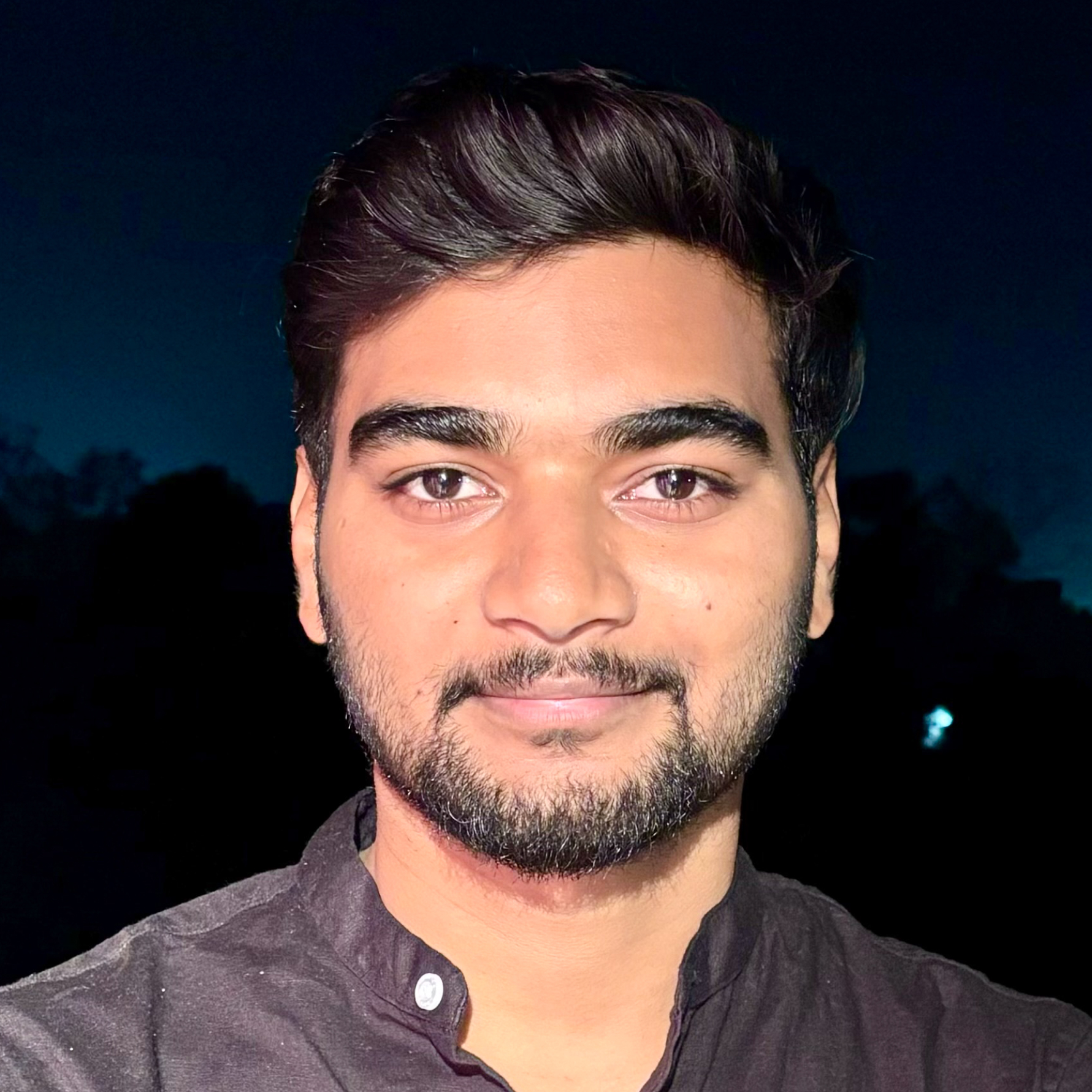
Pratik Patra
Research project
Optimization of orbit-to-charge conversion for magnetic readout in logic devices
Project supervisor
Prof. Fèlix Casanova, Prof. Luis Hueso
Recruitment date
01/09/2026
Hey everyone! I'm Pratik, from Odisha, one of India's most culturally rich and underrated states, known for its ancient temples, tribal heritage, and beautiful coastline.
Growing up there taught me to look deeper into things, which is probably why I ended up in physics. Outside the lab I play basketball, cricket, and enjoy running. The discipline and teamwork that comes with sport is something I carry into research too.
I have an Integrated Master's in Physics with a focus on Experimental Condensed Matter Physics. My work has been in magnetism and spintronics, where I tuned quantum materials and low dimensional van der Waals magnets, fabricated devices to study their magneto transport properties, and carried out real space observation of topological spin textures using LTEM.
What excites me about ORBIS is the chance to explore orbital angular momentum, a topic that is still wide open and full of untapped potential for real applications. There are so many questions we have not even begun to answer yet, and figuring them out will take new theories, fresh thinking, and collaborations. That kind of open territory is exactly where I want to be. But honestly, what draws me just as much is the people. The chance to connect with and learn from some of the leading minds in our field is something I do not take lightly, and I think that is where a lot of the real growth happens.
In the future I want to work at the crossroads of fundamental and applied physics, helping build the next generation of memory and logic devices through spin orbitronics. My project on MESO logic is a great starting point for that. Really happy and excited to start this journey!
Project Description
Orbitronics—using orbital instead of spin angular momentum—offers a promising route to more efficient information processing, with potentially larger signals and new mechanisms for generating and detecting angular-momentum currents. Building on this emerging field, this project aims to exploit the orbital Hall effect (OHE) to achieve enhanced electrical readout in T-shaped devices relevant for future magnetoelectric spin-orbit (MESO) logic, a post-CMOS technology platform.
Current MESO readout concepts based on the spin Hall effect are limited by insufficient output voltages. By contrast, the OHE may provide a significantly larger response, enabling practical device implementation. This PhD project will explore this opportunity through three focused research objectives:
Material Exploration of 3d Transition Metals
Investigate how resistivity and disorder influence the OHE in selected transition metals (Ti, V, Cr, Mn). Thin-film growth conditions and impurity engineering will be used to tune intrinsic and extrinsic mechanisms. Orbital Hall conductivity and orbital diffusion length will be quantified using Hanle magnetoresistance (HMR).
Device Fabrication and Orbital Injection
Integrate the most promising OHE materials into nanoscale T-shaped device architectures. Explore a range of ferromagnetic electrodes (Ni, Co, NiFe, CoFe, rare-earth alloys) to study electrical orbital injection and determine the orbital polarization of different ferromagnets.
Optimizing OHE-Based Readout for MESO Logic
Design and fabricate optimized OHE-based readout devices to maximize output voltage. Engineer spacer layers between the ferromagnet and OHE material to enhance orbital transparency and overall device performance.
Host institution
CIC nanoGUNE is a research center devoted to conducting world-class nanoscience research for a competitive growth of the Basque Country. NanoGUNE is a member of the Basque Research and Technology Alliance (BRTA) and is recognized by the Spanish Research Agency as a María de Maeztu Unit of Excellence.
The Nanodevices group, co-led by Prof. Luis E. Hueso and Prof. Fèlix Casanova, is currently composed of 30 members including senior and junior researchers. The group has at its disposal extensive research facilities for fabrication and characterization of devices and several active research lines in spintronics and optoelectronics in different systems such as 2D materials, chiral crystals, and altermagnets.
Planned Secondments
Academic Secondment
CNRS-Laboratoire Albert Fert
Palaiseau, France
Dr. Vincent Cros

Industrial Secondment
NELLOW
Grenoble, France
Dr. Jean Philippe Attané
Registering University
University of the Basque Country
Spain