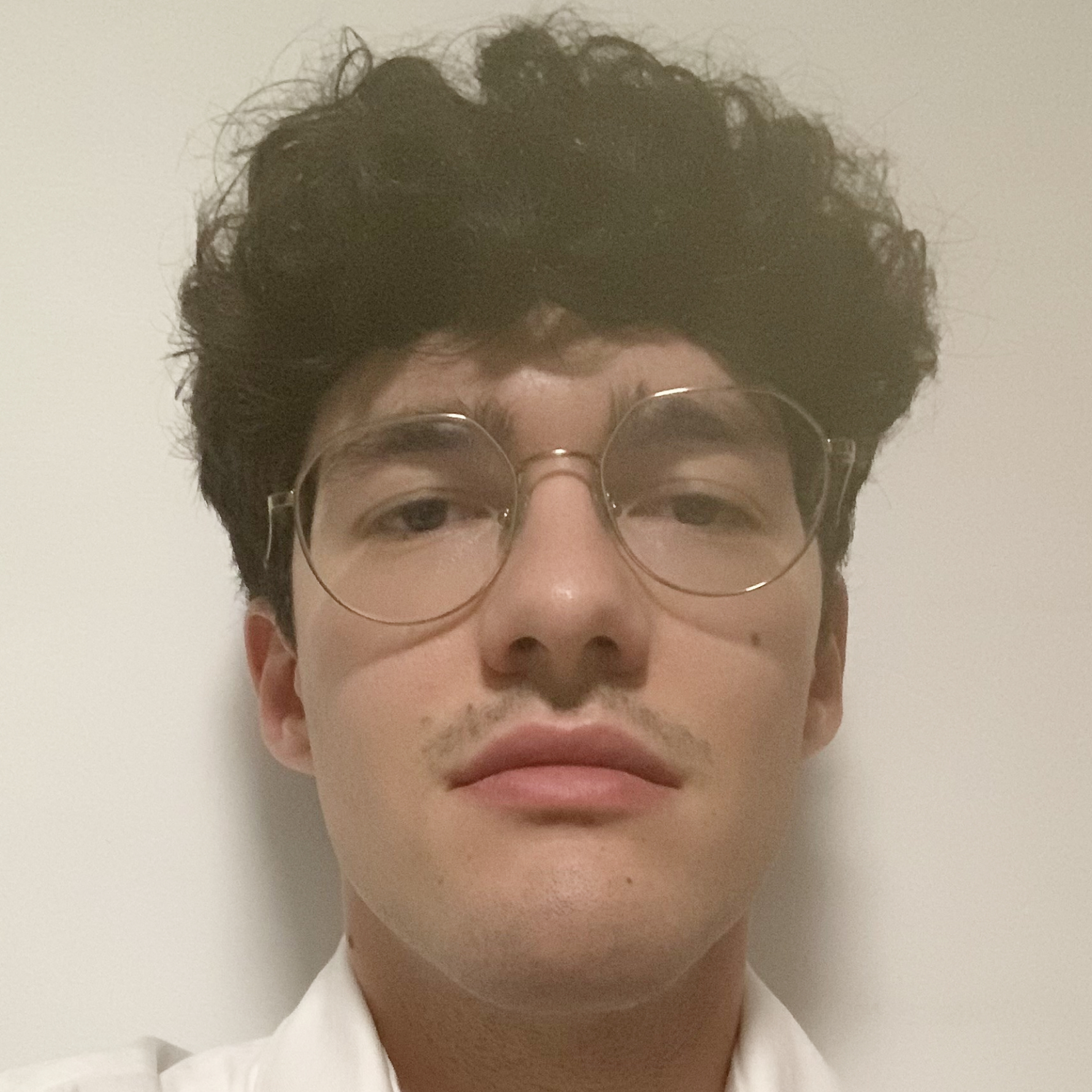
Francesco Clori
Research project
Ferroelectric control of orbital currents
Project supervisor
Dr. Laurent Vila
Recruitment date
01/10/2026
My name is Francesco, I am 24 years old, I was born in Turin, Italy.
Since I was young, I have always dreamed of becoming a scientist. Initially, I wasn’t sure whether I wanted to devote myself to theoretical work, or to experimental research. For this reason, I chose a hybrid academic path, starting with a bachelor’s degree in Engineering Physics at Politecnico di Torino, and for the master's, I was selected for a double-degree joint program between Politecnico di Torino and Université Paris Cité. The first year, I followed the master's degree in Nanotechnologies for ICTs, and in the second year, the M2 Quantum Devices program.
I chose to apply to ORBIS mainly because of the mission of this project: to create cheap, low-power, scalable, and environmentally sustainable orbital-based technologies within a European network.
In particular, I preferred the thesis at Nellow because it will give me the possibility to further investigate and better understand physical phenomena, and have the opportunity to fabricate state-of-the-art devices in the field of orbitronics.
What I know for my future is that I want to contribute to scientific research and have a positive impact on the advancement of technological progress.
Project Description
Ferroelectric materials allow the design of ultra-low power devices, thanks to the non-volatile nature of the ferroic order and its control with a pure voltage-based switching at the lowest switching energy possible. This ferroic order has a direct imprint into the orbital and spin texture of Rashba states appearing at their surface. The use of semiconductors rather than metals allows the harnessing of enlarged orbital current and their ferroelectric control. This opens a route to enhance the output voltage of FESO devices currently developed by NELLOW. Nanodevices will be fabricated using advanced lithography techniques, to allow an efficient spin/orbital injection and the control of the orbital-to-charge conversion through the ferroelectric state. Care will be taken at the interface quality between the ferroelectric material and the spin injection layer to avoid interdiffusion and spin back flow. The device will be characterized by magnetotransport experiments, and the signal will be modelled using finite element simulation of the spin drift transport equation, including the formalism of Rashba interconversion mechanism.
Host institution
NELLOW is a company targeting the market of microelectronic chips for logic operations and AI, thanks to the invention of a new type of component with ultra-low energy consumption: the FESO device. Protected by a portfolio of 12 patents, FESO results from 15 years of collaboration between world-leading research institutions in new microelectronic solutions (CEA, UGA, CNRS). This technology has the potential to become the global solution for computing and AI. In 2020, NELLOW founders contributed to the discovery of a remarkable new physical effect led to the invention of this technology. The FESO device combines spintronics with ferroelectricity, using quantum materials (2D electron gases in oxides) and ferroelectric semiconductors.
Planned Secondments

Academic Secondment
ETH Zürich
Zürich, Switzerland
Pietro Gambardella
Academic Secondment
CIC nanoGUNE
Donostia - San Sebastián, Spain
Luis Hueso
Registering University
Université Grenoble-Alpes
France