
Candidato de prueba 2
Research project
Timescales of Orbital/charge interconversion in Rashba systems
Project supervisor
Michel Viret and Jean-Yves Chauleau
Recruitment date
12/03/2026
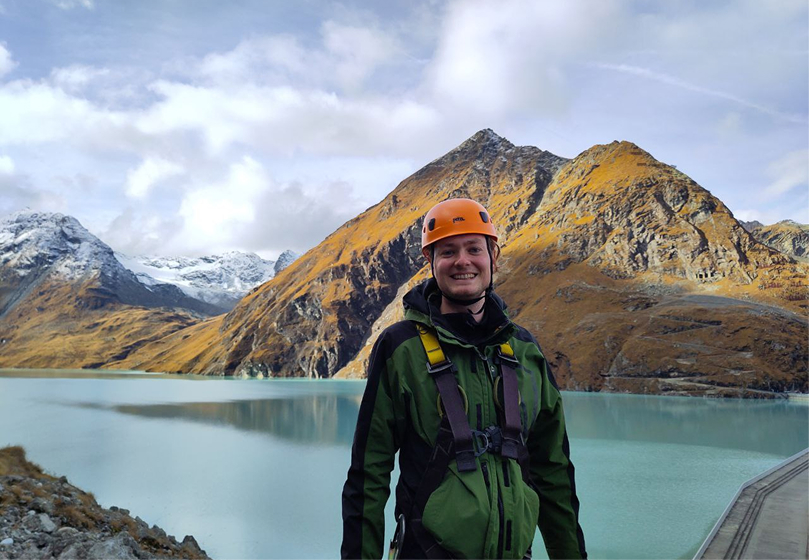
My name is Eoin Dolan, I’m from Ireland where I graduated with a Bachelor’s in nanoscience from Trinity College Dublin.
I then did a joint master’s in chemistry and materials engineering, in Paris and Genoa respectively as part of the Erasmus Mundus programme, with my thesis being on nanomagnetic phenomena in iron oxide nanoparticles. My main academic interest is in solid state physics, particularly magnetic phenomena, but I’ve also done some projects on computational catalysis, and atmospheric chemistry.
When I was looking at PhDs it was important for me that it be a project that was technologically relevant, and ideally in the field of computing hardware, since having spent a lot of time learning about CMOS technology, I was very aware of the upcoming roadblocks in improving current technology, and overcoming these challenges would be an amazing field to work in. Their focus on this area, combined with the network of hugely innovative companies represented in the SPEAR group made it seem like the perfect place to be – the hardest part was choosing which project to apply to.
I’m really looking forward to meeting everyone on the team and getting to start working on the project. I’m also very excited about living in a new city and learning a new language, or maybe two, trying the local food, and spending some time on the beach. After my PhD I’m hoping to pursue a research career in spintronics in an industrial setting, and I hope the skills I learn and people I meet during the project will be really helpful for that.
Project Description
The inverse Rashba-Edelstein effect, first demonstrated in 2013 in the Ag/Bi interface, has also been studied in other 2DEGs like the one that appears at the LaAlO3/SrTiO3 interface when LaAlO3 is epitaxially grown on TiO2-terminated SrTiO3 along the [001] direction. Although the two materials are insulators, electrons are transferred to the interface to compensate for the polar discontinuity present between them. A strong Rashba SOC also results from the breaking of inversion symmetry, whose strength can be tuned by applying an external electric field (back gate voltage). We have recently shown that this effect is mainly of orbital origin and not spin, hence uncovering the existence of the inverse OREE [1]. We have also carried out preliminary THz emission studies of the LaAlO3/SrTiO3 system showing a huge decrease in efficiency at the picosecond timescale. We attribute the effect to the nature of angular momentum transfer by hot electrons, but also to a probable slow intrinsic diffusion time in the 2DEG [2].
Therefore, it is important to measure the timescales associated with hot electrons and spin/orbital diffusion, as well as their angular variation in crystalline materials. The archetype LaAlO3/SrTiO3 system (deposited using pulsed laser deposition by our collaborators at the University of Geneva) will be central here, but other crystalline systems like Cu/CuOx and Ti/MgO or Co/Al may also be measured if time permits. The measurements will be in the DC regime by the spin Seebeck effect at variable temperature, and in the ultra-fast range using ultra-fast laser-induced demagnetization of a magnetic layer deposited on top and the study of the resulting emission. The timescales to be probed require the measurement of signals in the THz and GHz ranges. The injecting ferromagnetic materials will also be optimized for a better orbital vs spin injection.
References:
[1] Observation of the inverse Orbital Rashba-Edelstein effect, Anas El Hamdi, Jean-Yves Chauleau, Margherita Boselli, Clémentine Thibault, Cosimo Gorini, Alexander Smogunov, Cyrille Barreteau, Stefano Gariglio, Jean Marc Triscone and Michel Viret, Nature Physics 19, nᵒ 12, 1855 (2023).
2] Conversion of angular momentum into charge at picosecond timescales in the LaAlO3/SrTiO3 interface, Anas El Hamdi, Artem Levchuk, Cosimo Gorini, Margherita Boselli, Vincent Juvé, Tadele Orbula Otomalo, Gwenaëlle Vaudel, Stefano Gariglio, Pascal Ruello, Jean-Yves Chauleau and Michel Viret, Phys. Rev. B 110, 054412 (2024).
Host institution
CEA is a public research body active in the three fields of Energy, information and health technologies, defence and national security. With around 15000 employees, CEA maintains a cross-disciplinary culture of engineers and researchers, building on the synergies between fundamental and technological research.
The ‘Nano-magnetism and Oxides Laboratory’ (LNO-NOL) is involved in basic research in spintronics, nanomagnetism and oxides with widespread missions spanning all the way to bridging between new concepts and innovation in companies.
Planned Secondments

Academic Secondment
Johannes Gutenberg Universität Mainz (JGU)
Mainz, Germany
Prof. Dr. Mathias Kläui | Prof. Dr. Gerhard

Industrial Secondment
Beneficiary Thales (THALES)
Palaiseau, France
Dr. Romain Lebrun
Registering University

Université Paris-Saclay
France